
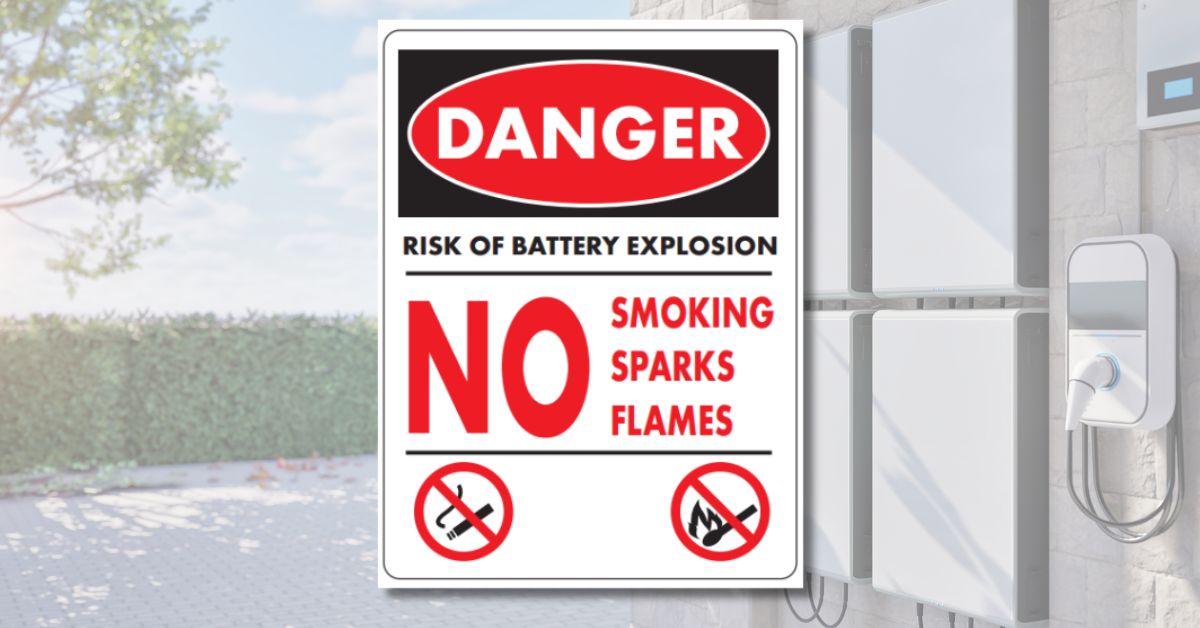
This article provides general guidance only and does not constitute compliance advice for a specific installation. Signage and labelling requirements vary by jurisdiction and network operator, so always confirm applicable federal, state, and DNSP requirements, along with manufacturer documentation, before finalising any installation.
The LFP battery explosive gas hazard question is one of the more frequently misunderstood areas of AS/NZS 5139 compliance and the answer has real implications for whether signage is required on your installation.
What is an LFP battery explosive gas hazard?
Explosive gas hazards are identified in AS/NZS 5139 Cl. 1.3.37 as a “mixture with air, under atmospheric conditions, of flammable substances in the form of gas or vapour which, after ignition, permits self-sustaining flame propagation which may cause harm to people, property, or the environment”. Boiling that down, basically there must be a gas which can ignite and produce a flame.
What AS/NZS 5139 Table 3.1 says about LFP batteries
Further to this in Section 3 of AS/NZS 5139 there are a few relevant references. First is Table 3.1 which identifies the applicable hazards for battery chemistries. At first glance this table is straightforward but it is in fact far from it. See a reproduction of that table below.
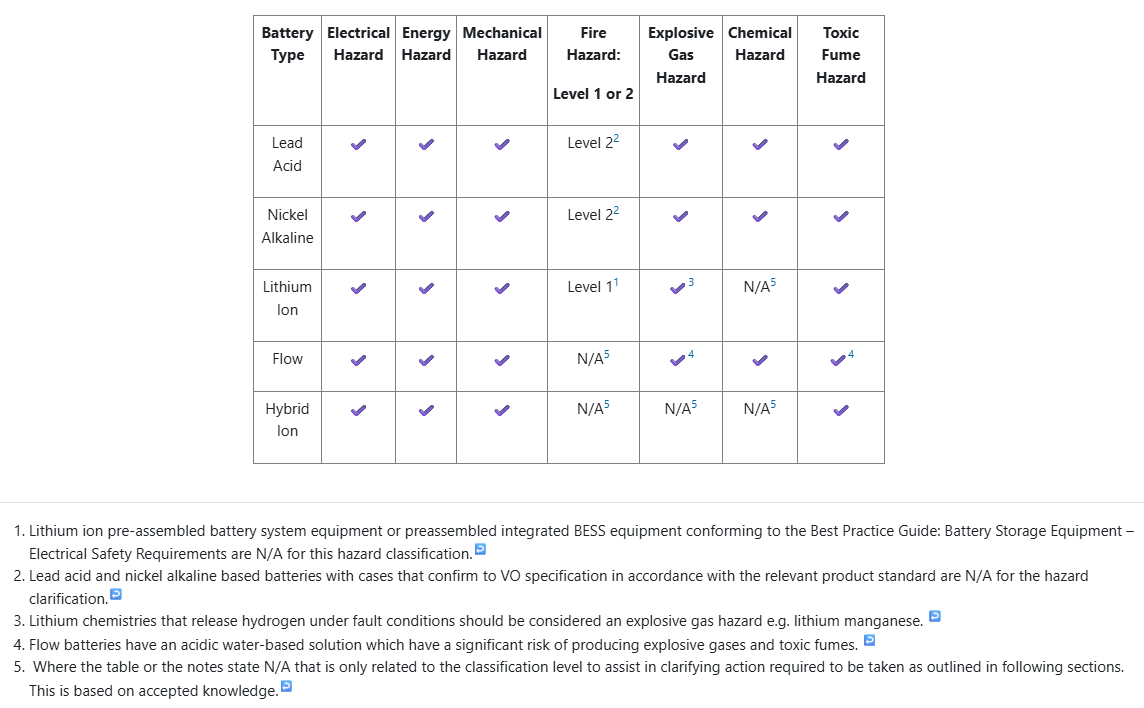
Here we see a few things regarding lithium ion batteries and explosive gas hazards. First is a check mark indicating the hazard exists, assuming note 3. Note 3 states that explosive gas hazards are applicable only to lithium chemistries which release hydrogen under fault conditions.
We did some review and found a few articles pointing to lithium iron phosphate (LFP) chemistries also emitting hydrogen in fault conditions. This article from NASA and this article from the Chemical Engineering Journal have led us to this conservative conclusion. We are specifically looking at LFP batteries because that chemistry has taken over the industry and is in the majority of CEC approved batteries.
However, the key word in Note 3 of Table 3.1 is “should”. Lithium chemistries that release hydrogen under fault conditions “should” be considered an explosive gas hazard. In all Australian standards “should” is merely a recommendation, only “shall” is a compliance requirement that must be met.
Later on in Section 3, under clause 3.2.7 Explosive gas hazards are expanded upon. Here it clearly says batteries which “generate explosive gases such as hydrogen when being charged… are deemed an explosive gas hazard”.
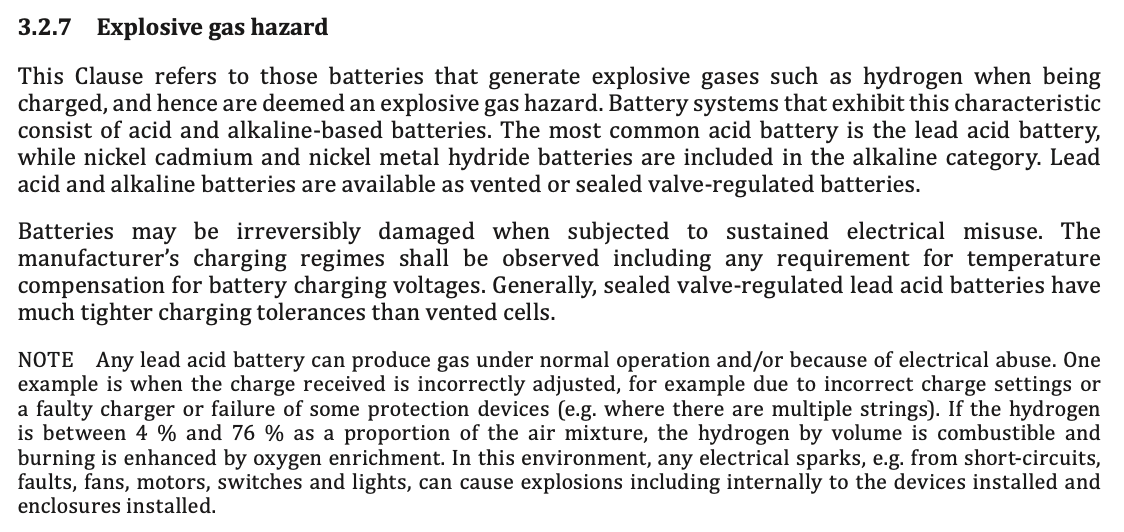
There is no mention of fault conditions, and it goes on to say that only acid and alkaline based chemistries exhibit this characteristic. We have also looked into the LFP chemical process and nowhere is hydrogen gas given off during regular charging.
So after all of Section 3, it seems that while considering LFP batteries an explosive gas hazard is a recommendation, we can not deem it to be a requirement. Let’s look at the other sections in the standard before making our final conclusion.
Sections 4 & 5
Here we take a look at clauses 4.3.5 and 5.3.5, where it only says that manufacturer instructions regarding ventilation must be followed. So if you, as the installer, maintain the required manufacturer clearances around the battery then this would be met.
Section 6: Hydrogen release and LFP chemistry
Here there is a little bit more information, and while CEC approved batteries do not apply to Section 6, it can still give us some insight into the nature of the hazard and the requirements. In Clause 6.3.5.1 we are again pointed to Table 3.1 and continuing the discussion on ventilation. 6.3.5.2.1, doubles down on what was said earlier and again clarifies that everything noted as the hazard in Table 3.1 is because it emits hydrogen during charging, and adds specifically it occurs after the charge has reached 95% or during boost charging or overcharging of the battery. LFP batteries do not exist this characteristic as for one they are fully sealed and don’t give off gases of any kind during normal operation. And two, hydrogen is not involved in the standard chemical reaction of LFP batteries.
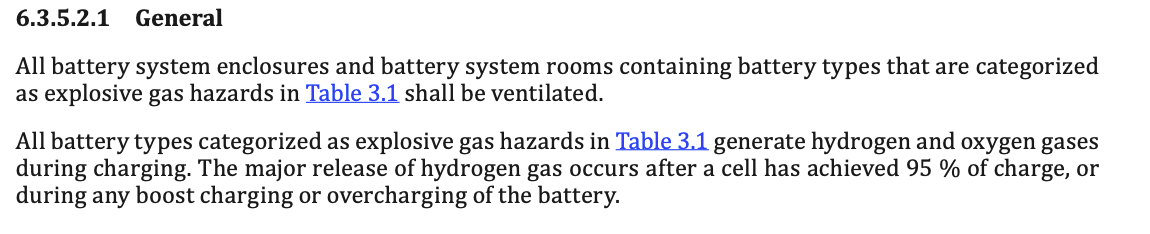
As we dive deeper into section 6.3.5 there is more detailed discussion on specific lead acid types (flooded vs. VRLA), various charging rates and requirements of ventilation rate in different spaces. All of which are not relevant to CEC approved LFP batteries.
Section 7: When does the danger signage requirement apply?
Clause 7.8 of AS/NZS 5139 states that if a BESS or Battery system is categorized as an explosive gas hazard, then it requires a “Danger, risk of battery explosion sign” adjacent to the enclosure or on all doors to the battery room. This is a distinct requirement from battery arc flash hazard signage, which is governed by separate clauses and applies under different conditions.

Manufacturer Documentation
As with everything, we not only have to follow the standards but also manufacturer documentation. In our experience, installation manuals have been rather silent on explosive gas hazards but SDS sheets provide more clarity. As we all know, copies of the SDS must be physical and in a protected sleeve in the MSB (Clause 7.7 AS/NZS 5139). While every SDS is going to be slightly different, there should always be a section devoted to hazards where clarity can be found.
Below are excerpts from the Sigenergy Sigenstor and Fox ESS SDS documents.
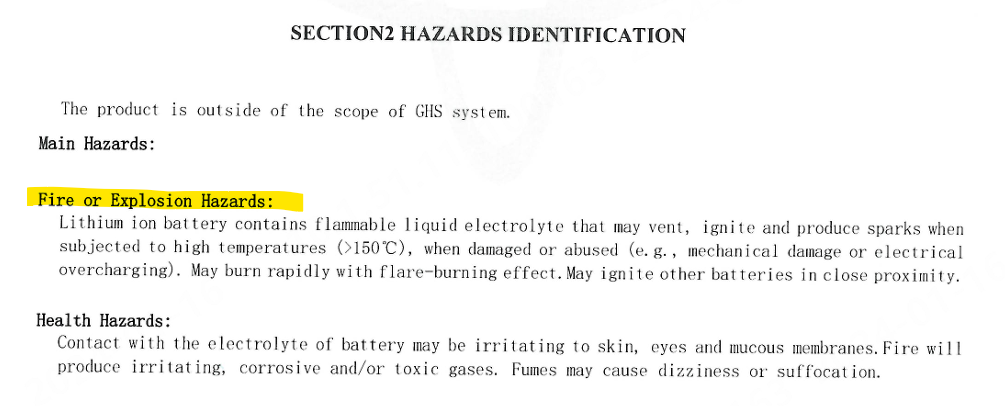
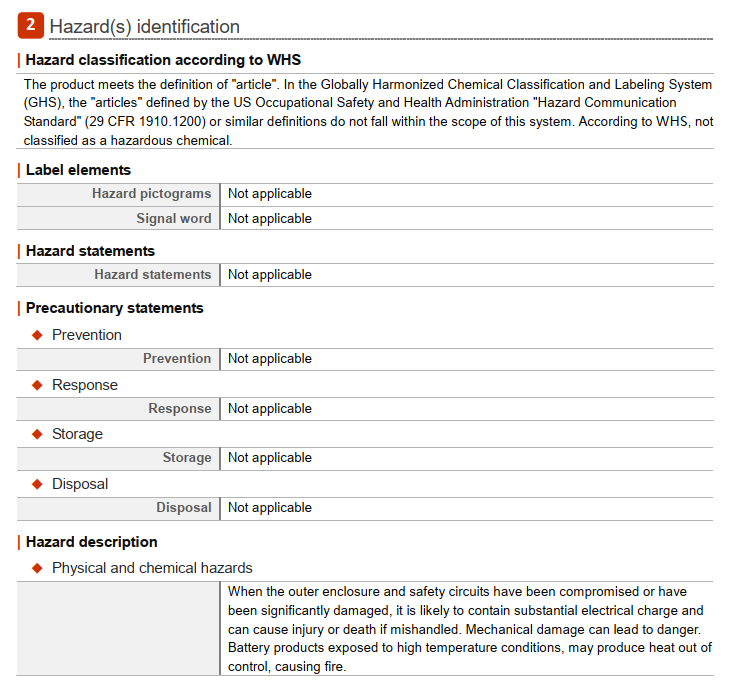
Taking these SDS documents as a case study, it seems clear that while there are the possibilities of fire due to damage or high temperature, there is nothing in either stating the possibility of explosion.
Conclusion
After walking through the AS/NZS 5139 standard in its entirety and looking into some manufacturer documentation we can make the final determination. While Table 3.1 may have explosive gas hazards selected for lithium ion batteries, Note 3 that follows states it is only a “should” and not a “shall” to consider fault conditions. That along with the rest of the standard including Clause 3.2.7 make it pretty clear that explosive gas hazards are meant to be considered during charging and normal operating conditions. And lastly, most manufacturer documentation such SDS documentation provide information about fire hazards due to damage or high temperatures, but do not discuss explosion hazards.
Thus, our determination is that explosive gas hazard signage is not required for Section 4 and 5 LFP batteries if it is omitted in the manufacturer documentation.
This article provides general guidance only and does not constitute compliance advice for a specific installation. Signage and labelling requirements vary by jurisdiction and network operator, so always confirm applicable federal, state, and DNSP requirements, along with manufacturer documentation, before finalising any installation.
For another commonly misunderstood area of battery system design, our guide on voltage drop cable sizing for solar PV and battery systems covers the cable length thresholds that determine when the calculation is actually necessary.
For a structured walkthrough of AS/NZS 5139:2019 and what it means for your installations, the GSES AS/NZS 5139:2019 Updates CPD course covers the standard’s key requirements in detail. Looking to gain full accreditation? Our Grid-Connected Battery Storage Systems Design and Install course covers compliant system design from the ground up.
This article was written with support and information provided by Tom Peters at AC Solar Warehouse.